Future Stirling
Reviewing the Strategic Community Plan to guide the City’s long‑term direction.


The local community describes Menora as mature, conservative and full of friendly people. To better understand what is means to be ‘a local’ our suburb profile seeks to understand the local stories Koora (past), Yeyi (present), Boordawan (future) and respond to Ngalang Maya (our place). This snapshot identifies the unique character of Menora’s neighbourhood and helps the City rethink how we deliver services with a local focus.
Menora means a seven-branched Jewish candelabra and is strongly associated with the Jewish community.
Menora traditionally has a strong association with the Jewish community. This is reflected in the name "Menora", which is a 7-branched candelabra that is used in Jewish religious ceremonies.
The area now known as Menora was once considered part of Mount Lawley. It was included in the land originally granted to Charles Bourne in 1840, but subdivision did not commence until the 1940s. The current name was chosen in 1954 and was influenced by the location of the Menora Picture Theatre in Walcott Street.
These are the top local priorities you've told us are important for Menora.
“Activate the ECU site once it moves to the city centre to be a community and live performance centre.”
As part of the redevelopment of the former ECU Mount Lawley campus, the Department of Creative Industries, Tourism and Sport (CITS) is engaging with creative organisations, industry partners, educational institutions, and local community members to inform a business case for the site's future use.
At this stage, the City has not received any confirmation regarding the future use or management of the former WAAPA facilities. The City will continue to engage with CITS as planning for the former ECU Mount Lawley campus progresses.
Visit the Development WA website to learn more about the ECU redevelopment.
"Dedicated pedestrian crossing on Alexander Drive to ECU for school and university kids, elderly crossing to the bus stop. This is decades overdue.”
The City, in collaboration with Main Roads WA, is exploring options to improve pedestrian facilities at the intersection of Alexander Drive and Bradford Street.
“More community events – I don’t hear much about them.”
The key output of the City's Events and Sponsorship service is to support the provision of a broad range of enjoyable, high-quality, inclusive and accessible public event experiences for the community, along with funding and support for local events. The annual calendar of events is curated to deliver a range of events across the City and includes a variety of food, craft and farmers markets, community movie nights, annual Christmas Carols and ANZAC Day events, music and performing arts and sporting events.
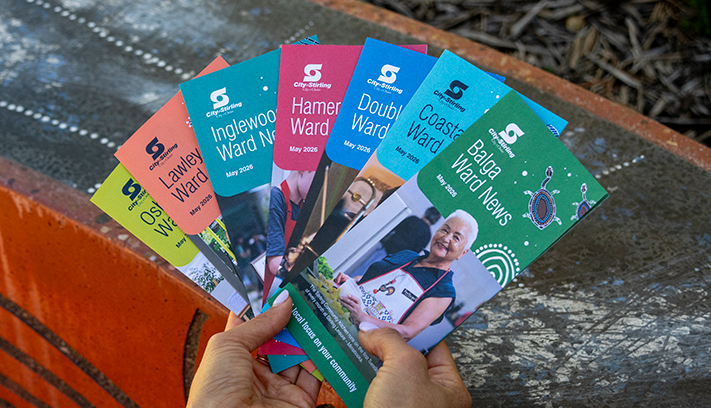
The City's Events Calendar on the website is a great source of information on upcoming events, as is the City's Facebook page with a monthly 'What's On' listing, Stirling Scene e-newsletters, and Ward Brochures.
Visit the City of Stirling events calendar.
“Better maintenance of the street verges."
While verges are public land managed by the City, the maintenance of verge treatments is the responsibility of the adjacent householder. This includes mowing lawns, weed control, pruning native gardens, topping up mulch and maintaining approved pavement or synthetic turf.
The City is responsible for maintaining street trees and footpaths. The City also mows verges on major roads only that require traffic management. If a verge elsewhere becomes unkempt to the point that it creates a safety or visibility issue, the City may step in to carry out a basic tidy-up only, with clippings left on site.
“Encourage all owners to preserve the heritage of their homes rather than a select few listed.”
The majority of suburbs Menora, Mount Lawley and Inglewood are within the City's Heritage Protection Area. Character Retention Guidelines apply to all homes within the Heritage Area and protections against the demolition of traditional homes built before 1960 are also included.
Learn more about heritage and development in the City.
Menora was designed on the principles of the garden suburb, and thus incorporated green streets, parks within walking distance of all residents and a curvilinear street system. As Menora was developed over a relatively extended period, it has a varied residential character.
The suburb contains a large number of character homes, with many buildings having significant heritage and cultural value. Architectural styles range from Californian bungalow to art-deco, post-war and international-style.
The dwellings are predominantly single detached residences on large lots and are generally of brick construction. Adair Parade contains the only significant agglomeration of unit developments. Many homes in Menora have recently been restored, allowing Menora to retain its unique character.
Menora contains some commercial ribbon development along Walcott Street, which allows local residents to access retail services. The suburb features a large number of public open space reserves and several pocket parks. These are used primarily for passive recreation, with the exception of a tennis centre in Alexander Park.
Saint Paul's Primary School is located to the south east of Menora and the area also contains several homes for senior citizens. A Jewish synagogue was opened on Plantation Street in 1973 and remains a significant spiritual focus for Perth's Jewish community.
Menora contains 12 local open spaces, one community open space and one district open space.
As an example of the character style in Menora, this house on Walcott Street, is a single storey dwelling displaying elements of Federation Bungalow style. It is located on a corner block, set back from the street behind a high limestone retaining wall and timber picket fence.
The dwelling is constructed from brick, tuck-pointed on both street facades, and a hipped and gabled tile roof with scrolled finials. A full width return verandah is incorporated under the main roof and is supported on square timber posts over limestone piers. There are timber-framed casement windows in a variety of configurations.
The place has aesthetic value as a good example of its architectural style and for its contribution to the historic streetscape.
 News
News Local events


City of Stirling kaadatj Nyoongar moort Nyoongar boodja-k Wadjak boodja-k. Ngalak kaadatj Nyoongar nedingar wer birdiya koora koora wer yeyi. Baalabang koondarm, malayin wer nakolak baalap yang ngalany-al. Ngalak dandjoo barn wer kaaratj bandang boodja-k.
The City of Stirling acknowledges the traditional custodians of this land, the Wadjak people of the Nyoongar Nation, and pays respect to the Elders both past and present for they hold the memories, the traditions, the culture and hopes of Aboriginal Australia.