
“Every tree starts with a conversation”: On the frontline with the Verge Tree Team
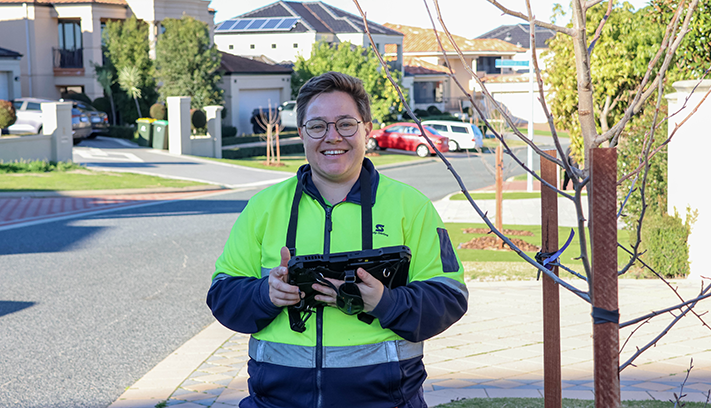
For Lydia Polglaze, some of the most challenging conversations at work can also be the most rewarding.
A City Trees Project Officer for the past three years, Lydia is often the person speaking with residents who aren't keen on having a tree planted on their verge.
“When I’m able to meet with residents and talk through the benefits of trees – what they do for our City, community and environment – they often come around and develop a better understanding and appreciation,” Lydia said.
“Seeing those trees eventually go into the ground and grow is incredibly rewarding.”
For Lydia’s colleague, a City Tree Maintenance Operator, one of the highlights is seeing residents embrace new trees and take pride in helping green their neighbourhood.
“A resident wanted to help dig the holes to plant their new trees,” he said.
“Nine trees were planted on a corner block, with lunch supplied by the resident for me!”
While verge trees can sometimes spark debate, recent community engagement identified “greener, more liveable neighbourhoods” as one of the highest priorities for City of Stirling residents.
Each year, the City plants around 7,000 trees across street verges, reserves and natural areas. That's roughly 560 trees per team member annually – a task that involves much more than simply digging a hole and planting a tree.
“Our team works hard to identify areas where tree planting will have the greatest impact on canopy cover and community wellbeing, while factoring in urban heat, soil types and growing conditions,” Lydia explained.
“Planning and ordering trees starts years in advance, all with the goal of achieving 30 per cent canopy cover on City-managed land by 2030.”
Lydia believes one of the biggest misconceptions is that verges belong to the adjacent property owner, when they are actually public land managed by the City.
“They’re spaces for installing services and infrastructure to support the community like water, power, footpaths and bus stops,” she said.
“And that includes trees. Trees are vital infrastructure. They provide oxygen, shade and visual amenity, and they play a key role in creating cooler, healthier and more liveable neighbourhoods.”
The City Tree Maintenance Operator emphasises that City trees must to be planted on verges, even if residents sometimes request they be planted within their property boundaries.
“Our team is here to work with the public to green up where you live and work for a cooler climate in the future,” he said.
To learn more about what you can (and can’t) do with your verge or ask us a question, visit the On the Verge project webpage.


